page title
Among the various user interface (UI) elements that constitute digital services, the Digital Government Service UI/UX Guidelines present detailed requirements that administrative and public institutions must comply with under the Electronic Government Act, the Guidelines for the Establishment and Operation of Information Systems of Administrative and Public Institutions, and the Electronic Government Website Quality Management Guidelines. These requirements include common components with high usage frequency that significantly impact user experience (UX) quality, as well as design and implementation guidelines for core tasks.
Background
The Republic of Korea has actively adopted digital technologies and has established world-class e-government services. As these digital services have expanded, the use of administrative services has gradually shifted from in-person to online channels, significantly improving citizens’ usage efficiency and enhancing the overall productivity. However, according to the 2022 Survey on the Use of Electronic Government Services and other related findings, digital government websites and apps are perceived as complex and difficult to use, indicating the need for improvement.
User experience research and UI/UX analyses of major digital government websites and apps have identified several key causes of inconvenience. These include repeated requests for identical actions, unclear explanations that hinder users from resolving issues on their own, and inconsistencies in procedures and presentation styles across services that offer similar purposes and functions, resulting in confusion and a greater learning burden for users.
Although continuous efforts have been made by many individuals involved in the development and operation of digital government services, the current approach—where each institution or department develops its own UI/UX—has reached its limits in optimizing user experience and improving the overall quality of public websites and apps. Accordingly, this guideline has been developed to establish a government-wide standard for building an efficient UI/UX development framework and to enable citizens to use diverse public websites and apps more intuitively and consistently, thereby reducing unnecessary time and effort.
Purpose
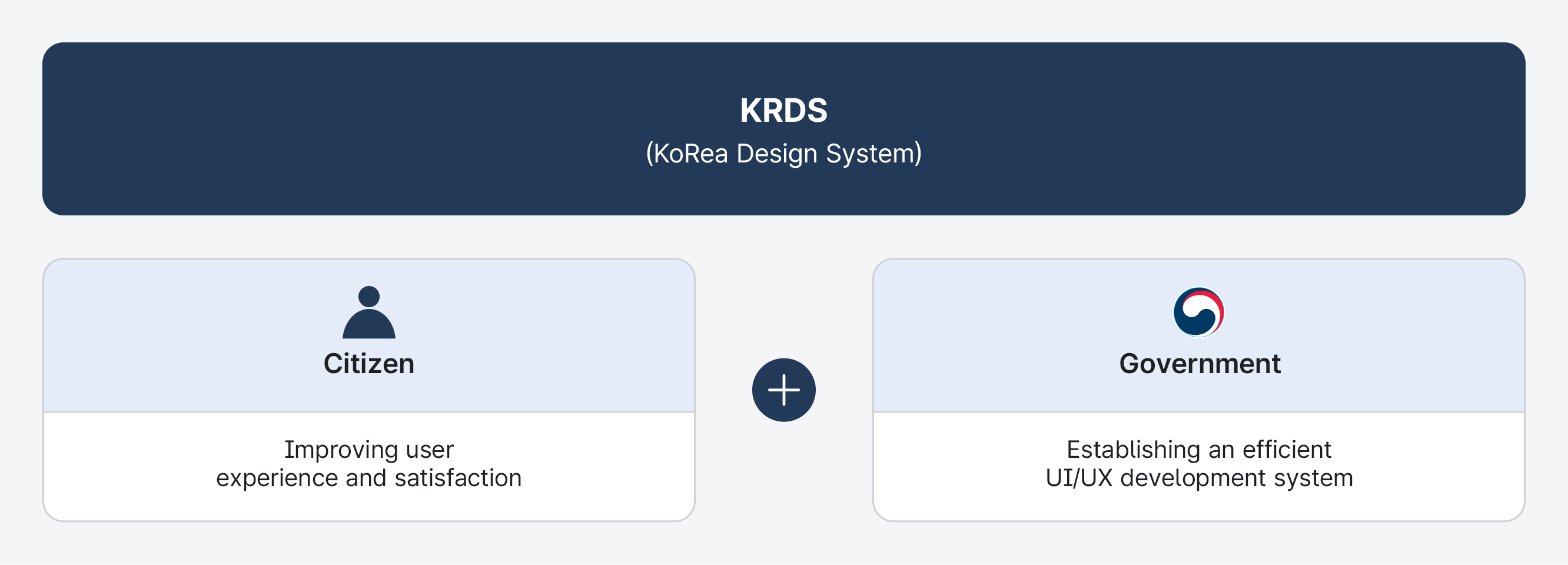
The purposes of this guideline are as follows:
-
1. To enhance user experience and improve user satisfaction
Designing the UI/UX of all digital government services to consistent standards enables users to access and use them more easily and efficiently.
-
2. To present approaches and guidelines to enhance user experience
Designing the UI/UX of all digital government services to consistent standards enables users to access and use them more easily and efficiently.
-
3. To reduce costs associated with UI/UX development and management
By offering consistent standards that can be referenced during the development of digital government services, this guideline supports communication among stakeholders and reduces the effort required for decision-making. It also helps minimize revisions and corrections caused by design inconsistencies, thereby contributing to cost savings.
Development Process
This guideline was developed based on an analysis of the current UI/UX status of major digital government websites and apps.
-
1Selection of Analysis Targets
To ensure applicability across various types of digital services and user environments, a broad range of digital government services—such as information delivery and civil service processes—were selected as analysis targets.
-
2Analysis of UI/UX Status
The analysis was conducted not only through expert evaluations but also by examining empirical user behavior data and citizen feedback.
-
3Derivation of the Guideline Scope
Through comprehensive analysis, components frequently used across different services and UI/UX issues repeatedly identified or that disrupted service use were selected to determine the scope of this guideline. The guideline's detailed content was structured around solutions to the UI/UX issues identified during the analysis and included general requirements for using each component.
-
4Finalization of the Guideline Structure and Content
The guideline was finalized by incorporating review comments from domain experts and practitioners responsible for operating and developing digital government services. Usability evaluation results for user interfaces developed in accordance with the guidelines were also reflected. Based on these findings, revisions and refinements were made to confirm the final structure and content.
Target Users
This guideline has been developed for all individuals involved in the planning, development, operation, and management of digital government services. Service operators, administrators, planners, designers, UI/UX designers, publishers, and developers can refer to this guideline according to the needs and objectives of their projects.
Key Features
Understanding the key features of this guideline helps users better comprehend its structure, how it can be applied, and the details presented throughout the document.
-
 Presenting practical solutions to core UI/UX issues from the user’s perspective
- Analyzes the inconveniences and difficulties users experience when accessing digital government services, based on VOC data, citizen evaluations, and usability and accessibility assessments.
- Provides usability, accessibility, and interaction guidelines grounded in user data analysis.
- Offers concrete guidelines to enhance the user experience by considering the user journey—beyond individual components or single screens—toward achieving the intended purpose of service use.
-
 Content Structure for Effective Application of the Guideline
- Principles: High-level principles that define the direction and design standards of UI/UX for digital government services.
- Style: Rules for visually consistent representation of components and basic patterns.
- Components: Guidance on common UI elements that represent the smallest units of the interface and are used consistently across tasks.
- Basic Patterns: Guidance on sets of user interface elements that are repeatedly combined to perform core tasks.
- Service Patterns (Core Task Patterns): Standard procedures and user experience design guidelines for key services provided through digital government websites and apps.
-
 Providing Specific Guidance for Inclusive UI/UX Design and Implementation
- Provides accessibility guidelines for each component category, including style, components, basic patterns, and service patterns.
- Establishes criteria to help achieve Level AA compliance with WCAG 2.1, the international standard for web content accessibility.
-
 Offering Guidance to Ensure Consistency Across Digital Government Services
- Specifies design principles to support shared direction and goals for UI/UX design in digital government services.
- Provides guidance based on identity elements and reusable components of digital government services.
-
 Establishing Flexible Standards that Reflect the Unique Characteristics and Types of Services
- Presents style application criteria that institutions can select according to their specific characteristics.
- Provides component design guidelines categorized based on analyses of digital government services.
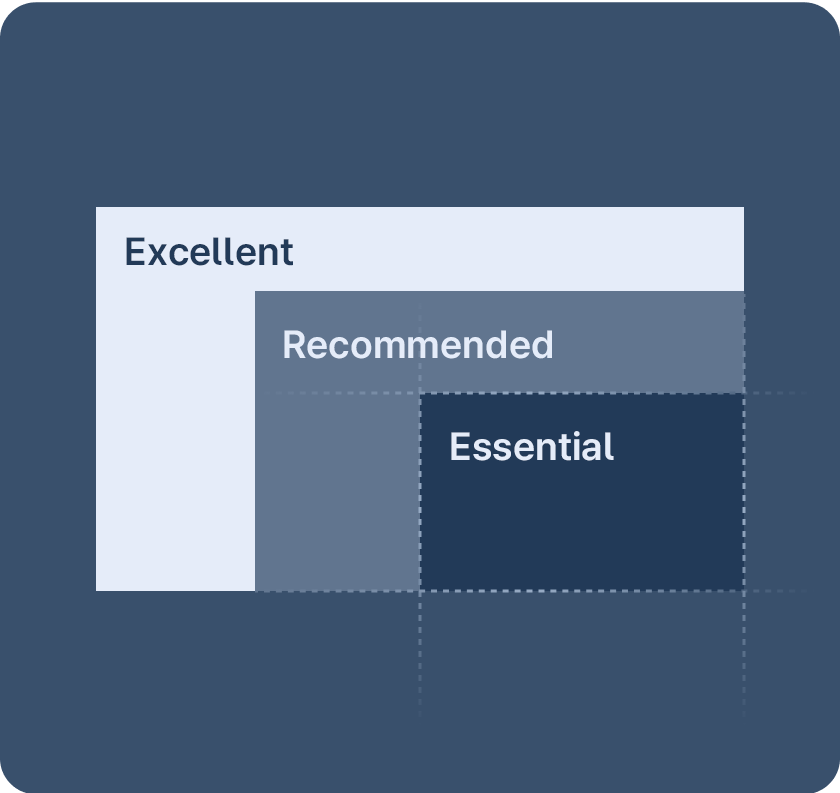
- Introduces a three-level application framework—Do (Essential), Better (Recommended), and Best (Optimal)—within service patterns so that service operators can apply the guidelines according to their operational context.
-
 Providing Reference Examples to Improve Understanding and Ensure Accurate Application
- Standard prototypes that support understanding of the core service pattern guidelines.
- Image examples that illustrate the usage, types, and structure of each component.
- Best-practice and cautionary examples presented through images to support accurate application of the usability guidelines.
Scope of Application and Standards
All websites, mobile websites, and apps developed and operated by administrative and public institutions must comply with the principles of this guideline, as well as the detailed guidance on style, components, basic patterns, and service patterns for UI/UX design and implementation.
The usability guidelines for service patterns follow a three-level application framework—Essential, Recommended, and Optimal. Institutions must first comply with the Essential items, then expand their application to Recommended and Optimal items in accordance with their service context and implementation plans.
Application Levels (Service Patterns)
Among the components of this guideline, the usability guidelines for service patterns are categorized into three application levels based on their importance and impact from the user’s perspective. To improve the user experience of core services, institutions must comply with the Essential level of guidelines, which serves as the minimum required standard.
When referring to the application levels, it should be noted that compliance with a higher-level guideline does not guarantee compliance with lower-level guidelines. Most guidelines at the highest level are designed to be effective only after lower-level guidelines have been met.
Classification of Application Levels
-
Essential
When the guideline is followed:
- Satisfaction can increase only to a basic, broadly expected level (a fundamental user experience).
When the guideline is not followed:
- Tasks may directly fail.
- Users may be unable to complete tasks on their own when issues arise.
-
Recommended
When the guideline is followed:
- Satisfaction can improve for a broader range of users (a practical user experience).
When the guideline is not followed:
- The level of task difficulty may increase, but it does not necessarily lead to task failure.
- Even if issues occur, users may struggle to find appropriate solutions on their own.
-
Optimal
When the guideline is followed:
- Satisfaction can increase significantly when the guideline is applied correctly (a highly engaging experience).
When the guideline is not followed:
- Users may experience inconvenience or inefficient procedures.
- It becomes challenging to provide an optimal experience for users across a range of different situations.
Scope of Use
This guideline has been developed to serve as a reference for the design and development of UI/UX for websites, mobile web, and app services. However, native user interface components, interaction methods specific to each mobile operating system, and screen or navigation models unique to mobile apps were not considered in this guideline. Therefore, when applying this guideline to the design and development of mobile apps, institutions should refer to 'Improving UI/UX for Mobile Services' and use the guidance according to their specific service context.
Relevant Regulations
Electronic Government Act, Guidelines for the Establishment and Operation of Information Systems of Administrative and Public Institutions, Electronic Government Website Quality Management Guidelines, Guidelines for the Development and Operation of Administrative and Public Institution Websites, and Korean Web Content Accessibility Guidelines.